
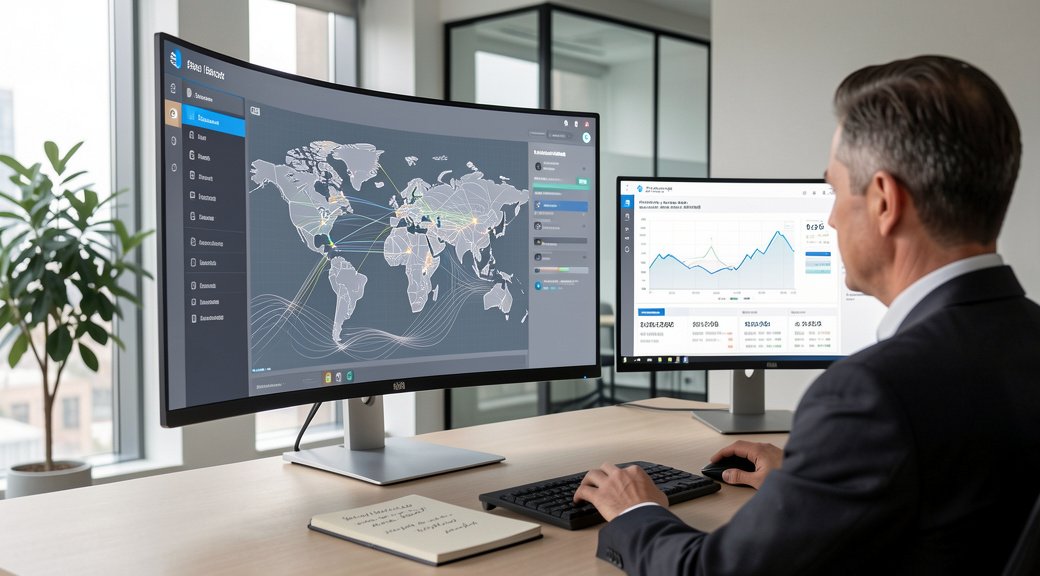
For US small and lower mid-market businesses, the promise of global AI automation services often collides with a harsh reality: fragmented point solutions, unclear ROI, and implementation cycles that stall growth instead of accelerating it. Decision-makers are presented with a world of potential,automated workflows, intelligent customer interactions, and data-driven operations,yet struggle to translate this into a coherent, executable strategy that delivers tangible business outcomes. The core problem isn’t a lack of available technology, but a systemic failure to integrate AI automation as a foundational component of business infrastructure, leading to wasted investment and missed scaling opportunities.
This article provides a structured framework for evaluating and implementing global AI automation services. You will gain a clear understanding of how to move beyond tactical tool adoption to build a strategic automation layer that enhances operational capacity, improves financial predictability, and creates a scalable platform for sustainable growth, positioning your business to compete effectively in an increasingly automated marketplace.
The Root Cause: Treating Automation as a Tool, Not a System
The most significant error businesses make is approaching AI automation as a series of discrete software purchases aimed at solving isolated pain points. A customer service chatbot here, an invoice processing script there. This tool-centric mindset ignores the interconnected nature of business operations and creates new problems: data silos, inconsistent user experiences, and maintenance overhead that grows exponentially with each added point solution.
This fragmentation is the primary barrier to realizing the promised value of global AI automation services. True automation is not about replacing human tasks with software but about redesigning processes into coherent, self-optimizing systems. When automation is bolted onto broken or inefficient processes, it merely accelerates the dysfunction. The strategic failure lies in not first mapping and optimizing the core operational workflow before applying technological leverage.
The Operational and Financial Impact of Disconnected Automation
The consequences of a fragmented approach are measurable and severe. Operationally, teams waste time context-switching between incompatible platforms. Data generated by one automated process cannot flow seamlessly to inform another, crippling decision-making. Customer experience suffers when different departments use disparate automation tools that don’t share information, leading to repetitive questions and fractured interactions.
Financially, the impact is twofold. First, there is the direct cost of licensing multiple platforms, each with its own subscription fee and implementation cost. Second, and more damaging, is the opportunity cost of lost efficiency and scalability. Manual bridges between automated systems require human labor, creating a hidden tax on growth. The business hits an operational ceiling where adding revenue requires disproportionately adding overhead, because the infrastructure does not scale with the business vision.
Common Strategic Mistakes in Selecting AI Automation Services
Beyond the systemic error, several tactical missteps consistently derail automation initiatives:
- Chasing Novelty Over Reliability: Selecting services based on cutting-edge features rather than proven stability, integration capabilities, and long-term vendor viability. The most advanced AI is worthless if it fails under load or cannot connect to your core systems.
- Neglecting the Integration Tax: Underestimating the time, cost, and complexity of connecting new automation services to existing business software and databases. This often becomes the project’s critical path.
- Over-Automating Too Soon: Attempting to fully automate complex, poorly documented processes before they are standardized. Automation requires consistency; injecting AI into chaotic workflows amplifies the chaos.
- Ignoring the Human-in-the-Loop Design: Failing to design clear escalation paths and oversight mechanisms. Effective automation handles the routine and flags the exceptional for human judgment, requiring thoughtful interface and experience design.
A Structured Framework for Implementing Global AI Automation
Successful automation requires a phased, systems-oriented approach. This framework moves from assessment to orchestration, ensuring each step builds upon a stable foundation.
Phase 1: Process Audit and Quantification
Begin by mapping your core revenue-generating and operational support processes. Identify inputs, decision points, outputs, and the personnel involved. Crucially, quantify the current state: time per instance, error rates, and labor cost. This audit isn’t about finding tools; it’s about identifying the processes with the highest volume, lowest complexity, and highest cost,the prime candidates for initial automation. This objective baseline is essential for measuring true ROI.
Phase 2: Architectural Planning and Vendor Selection
With target processes identified, design the desired system architecture. Will you use a single-platform suite or a best-of-breed approach integrated via API? This decision hinges on your existing custom software and database landscape and long-term scalability needs. When evaluating global AI automation services, prioritize:
- Open API and Integration Depth: The service must play well with others.
- Data Ownership and Portability: You must control and extract your data.
- Security and Compliance: Ensure it meets your industry standards (e.g., SOC 2, GDPR).
- Scalability Model: Costs should align predictably with usage, not spike unexpectedly.
Phase 3: Pilot Implementation and Integration
Select a single, contained process for a pilot. The goal is not to save money but to learn. Implement the automation service, focusing intensely on the integration points with your existing systems. This phase tests the vendor’s claims, your team’s adaptability, and the real-world workflow. Measure everything against the baseline from Phase 1. A successful pilot proves the concept and provides a blueprint for scaling.
Phase 4: Scaling and Orchestration
With a proven pilot, begin sequencing the rollout of additional automated processes. The focus now shifts from single-point solutions to orchestration,how these automated workflows interact. This is where the transition from tools to a system occurs. You may implement a central workflow engine or leverage multi-agent systems to manage handoffs between different specialized automations, ensuring a cohesive operational layer.
The Strategic Role of Supporting Systems
AI automation does not exist in a vacuum. Its efficacy is multiplied or diminished by the quality of the business infrastructure it connects to.
Automation and Conversion-Focused Website Infrastructure
Your website is often the primary source of customer input. Intelligent automation can transform this front-end. For instance, AI can qualify leads from form submissions or chat interactions in real-time, routing them directly to the appropriate sales resource or triggering a personalized nurture sequence. This requires your website to be more than a digital brochure; it must be a structured, data-generating asset built with clean code and clear conversion paths. Automation turns the website from a passive destination into an active participant in customer acquisition and support, a principle central to conversion-focused website infrastructure.
Feeding Automation with Organic Growth Systems
Automation thrives on consistent, predictable input. A sporadic lead flow makes marketing automation clunky and inefficient. This is where a systematic approach to organic growth is critical. A predictable engine of inbound interest, built through integrated SEO and content strategy, provides the steady stream of opportunities that automation can efficiently process and nurture. Think of organic growth systems as the fuel pump for your automation engine. Without consistent fuel, even the best engine sputters.
The Backbone: Custom Software and Data Scalability
Off-the-shelf automation services often hit a wall when they encounter unique business logic or legacy systems. This is where custom software development plays a decisive role. A custom application or middleware can act as the central nervous system, orchestrating data flow between a global AI service and your proprietary operations. Furthermore, the value of automation is locked in the data it generates. Ensuring your database architecture can scale to store, process, and analyze this new data stream is a non-negotiable prerequisite for long-term success.
Implementation Considerations for US Businesses
When working with global providers, US small and mid-market firms must be pragmatically strategic:
- Data Residency and Privacy Laws: Ensure service level agreements (SLAs) specify compliance with US state-level regulations (like CCPA) and any industry-specific rules.
- Support and Service Level Agreements (SLAs): Verify the availability of support in your time zone and the guaranteed uptime for critical processes. A 99.9% uptime SLA is meaningless if outages occur during your peak business hours.
- Total Cost of Ownership (TCO): Model costs beyond the subscription: integration work, ongoing maintenance, training, and potential costs for data egress or additional API calls.
- Change Management: Plan for internal communication and training. Automating a process changes team roles. Proactively redesign roles around higher-value tasks that the automation cannot perform.
Positioning for Long-Term Evolution
The landscape of AI automation is evolving rapidly. The most forward-thinking approach is to build an automation layer that is itself adaptable. This means selecting services and building integrations with an eye toward modularity. The goal is to create a system where individual components (e.g., a specific NLP engine or data processor) can be upgraded or swapped out as technology improves, without requiring a wholesale platform migration. This requires an architectural discipline that treats automation as core business technology infrastructure, not a disposable application.
Frequently Asked Questions
What is the realistic ROI timeline for implementing global AI automation services?
Expect a 6,18 month horizon for full ROI realization. The initial 3,6 months often see increased costs due to integration and training. Operational efficiency gains typically materialize in months 6,12, with full financial impact,including revenue growth from improved sales cycles and customer retention,becoming clear in the 12,18 month window, provided implementation follows a structured framework.
How do we ensure our data is secure when using a third-party global automation service?
Conduct thorough due diligence: require SOC 2 Type II reports, review data encryption standards (both in transit and at rest), understand the provider’s data subprocessor list, and negotiate clear terms in your contract regarding data ownership, breach notification, and right-to-audit. For highly sensitive data, consider architectures that keep core data in-house while sending only necessary snippets to the AI service.
Can our existing, legacy software systems integrate with modern AI automation platforms?
In most cases, yes, but the path varies. Modern platforms offer RESTful APIs. Legacy systems may require custom middleware,a bridge application,to translate and shuttle data. The feasibility and cost depend on the legacy system’s architecture. An audit of your current tech stack’s integration points is the essential first step.
We’re a small team. How do we manage the ongoing maintenance of these automated systems?
Factor maintenance into your initial design. Choose platforms known for stability and clear monitoring dashboards. Design alerts for process exceptions, not just system downtime. Many businesses find that partnering with a managed service provider or a technology partner like Shelby Group LLC, which can provide ongoing oversight as part of a strategic growth framework, is more cost-effective than building this niche expertise in-house prematurely.
How do we choose between a single all-in-one automation suite and multiple best-of-breed services?
The “suite vs. best-of-breed” decision hinges on your priority: cohesion or peak capability. Suites offer easier integration and one vendor to manage but may have weaker capabilities in specific areas. Best-of-breed offers top performance per function but introduces significant integration complexity and multi-vendor management. For most SMBs, a hybrid approach,a core suite for fundamental workflows, augmented by one or two best-of-breed tools for critical functions,offers the best balance.
Conclusion
The effective use of global AI automation services is not a technology project; it is a business discipline. It requires moving beyond the allure of individual tools to embrace a systems mindset where automation becomes the operational layer upon which scalable growth is built. Success is measured not by the number of processes automated, but by the increase in strategic capacity,the ability of your business to handle more volume, complexity, and opportunity without a linear increase in operational overhead. This transition, from manual execution to automated orchestration, is the defining competitive advantage for the next decade of US small and mid-market business growth. It demands a partner focused not on selling discrete solutions, but on architecting and maintaining the resilient infrastructure that allows your business to execute its vision predictably and at scale.
