
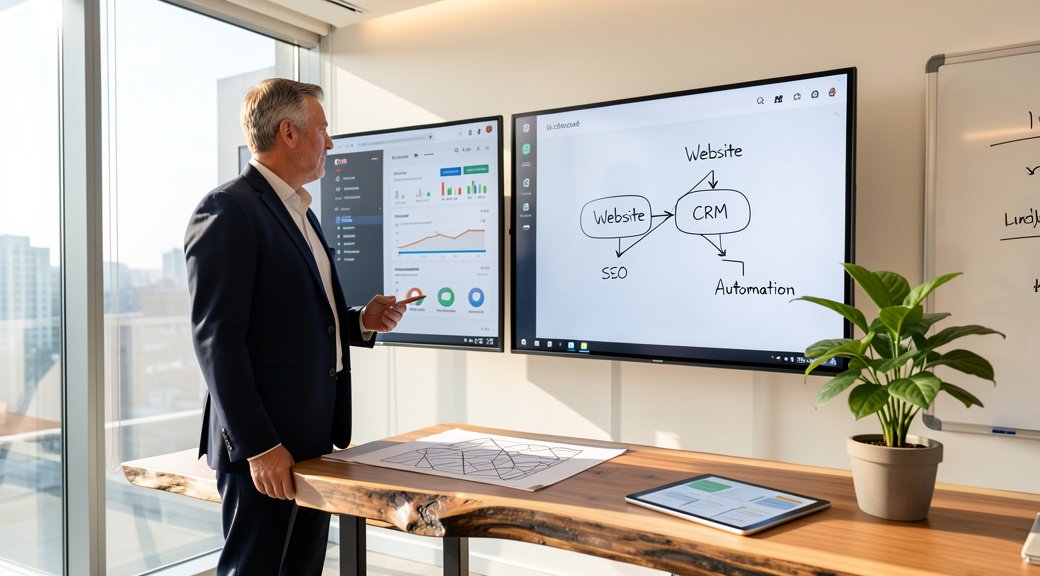
For US small and lower mid-market businesses, a website is often the single largest investment in digital infrastructure. Yet, year after year, founders and operators watch this asset underperform. It generates sporadic leads, fails to reflect operational efficiency, and becomes a constant source of technical debt and vendor management headaches. The core problem isn’t a lack of effort or investment in WordPress development; it’s a fundamental misalignment between the website’s technical architecture and the business’s growth systems. When your website is built as a detached marketing brochure rather than integrated conversion infrastructure, it cannot scale with your operations or reliably contribute to revenue.
This article is for business leaders who view technology as an operational lever, not a cost center. We will analyze why most WordPress projects fail to deliver business outcomes, detail the tangible financial and operational impacts of these failures, and provide a structured framework for developing WordPress as a core component of your growth infrastructure. You will gain a clear understanding of how to approach WordPress not as a one-time project, but as a scalable system that supports SEO, automates customer journeys, and converts traffic predictably.
The Root Cause: Treating Development as a Project, Not an Infrastructure Investment
The most significant mistake businesses make is approaching WordPress through a project-based lens. The cycle is familiar: a redesign is commissioned, a list of features and pages is delivered, the site launches, and the developer relationship ends or becomes purely reactive. This model severs the direct connection between your website’s capabilities and your evolving business processes.
Operational and Financial Impact of the Project Model
The consequences are measurable. From an operational standpoint, marketing teams cannot execute campaigns without developer intervention. Sales teams lack integrated tools for lead qualification. Customer service portals are bolted on awkwardly. Financially, this leads to:
- Hidden Ongoing Costs: Every content update, form change, or integration tweak requires a new scope of work and invoice.
- Lost Conversion Revenue: Inability to quickly test and optimize landing pages or user flows means leaving money on the table from existing traffic.
- SEO Stagnation: Technical SEO becomes a periodic “clean-up” effort rather than a baked-in, continuously improving system, causing organic growth to plateau.
- Integration Debt: Critical business tools (CRMs, marketing automation, proprietary software) connect through fragile, custom-coded patches that break with updates.
Common Architectural Mistakes in Business WordPress Development
Beyond the project mindset, specific technical and strategic missteps cripple a website’s long-term value.
1. The “Plugin Overload” Strategy
Solving every need with a separate plugin creates a bloated, conflict-prone, and insecure site. Performance slows, management becomes a nightmare, and the site’s core architecture is controlled by dozens of third-party developers with conflicting priorities.
2. Design-Centric, Not Conversion-Centric, Builds
Prioritizing aesthetic trends over structured conversion paths results in beautiful websites that don’t guide visitors toward business goals. Key elements like clear calls-to-action, intuitive information architecture, and strategic content placement are afterthoughts.
3. Neglecting the Core Business System Integration
The website operates in a silo. Lead data doesn’t flow cleanly into the CRM. Customer status isn’t reflected in user portal access. E-commerce inventory isn’t synced with warehouse management systems. This creates manual work and data errors.
4. No Clear Path for Content & SEO Evolution
The site is not built with a content engine in mind. Publishing new, optimized content is cumbersome. Page speed, schema markup, and a clean technical foundation are not considered part of the initial architecture, making future SEO gains an uphill battle.
A Structured Framework: WordPress as Conversion-Focused Infrastructure
The solution is to architect your WordPress installation as a primary business system from the outset. This requires a shift from asking “What pages do we need?” to “What business functions must this platform perform?”
Pillar 1: Foundation for Organic Growth & SEO Systems
Your website’s codebase is the foundation of your organic growth. This isn’t about keywords alone; it’s about building a technically superior asset that search engines can efficiently crawl and users love to use. Infrastructure-level considerations include:
- Core Web Vitals as a Baseline: Development choices (theme, plugins, custom code) must prioritize loading performance, interactivity, and visual stability from day one.
- Structured Data as Standard Practice: Schema markup for business information, products, FAQs, and events should be programmatically integrated, not manually added per page.
- A Truly Modular Content Architecture: Using Advanced Custom Fields or custom post types to create flexible, repeatable content components that empower marketers to build SEO-rich pages without developer help.
This is where a systematic approach, like our Organic Stack, becomes critical. It’s not a magic solution, but a defined infrastructure and process for ensuring these technical SEO and content fundamentals are not one-time optimizations but permanently embedded characteristics of your site. It turns your WordPress installation into a reliable, scalable engine for inbound lead generation.
Pillar 2: Engine for Business Process Automation & AI
WordPress should be a hub that automates interactions and data flow. This means:
- Intelligent Form & Lead Routing: Forms that qualify leads based on responses and automatically assign them to the correct sales rep or list in your CRM.
- Dynamic Personalization: Using first-party data (like past visits or form submissions) to tailor content blocks, offers, or navigation for logged-in users or known leads.
- AI-Enhanced Interactions: Integrating AI chatbots for initial qualification, using natural language processing for advanced site search, or automating content summarization and tagging.
Pillar 3: The Conversion-Focused Website Infrastructure
Every element is built with a measurable outcome in mind. This involves:
- Strategic Information Architecture: Organizing content and navigation based on user intent and the buyer’s journey, not internal company structure.
- Built-in Conversion Architecture: Standardized, easily testable landing page templates, clear primary and secondary CTAs on all pages, and integrated analytics for tracking micro-conversions.
- Performance as a Feature: Recognizing that site speed directly impacts conversion rates and designing the hosting environment, asset delivery, and code to maximize it.
Pillar 4: Gateway to Custom Software & Database Scalability
For businesses with unique processes, WordPress should be a robust front-end or a starting point for custom applications.
- WordPress as a Headless CMS: Using WordPress to manage content while a separate, custom-built front-end (in React, Vue.js, etc.) handles the user experience for complex, application-like interactions.
- Custom Plugin Development: Building proprietary functionality as a dedicated plugin to handle unique business logic, ensuring it remains independent of theme changes and is easily maintainable.
- Scalable Database Design: Planning for how custom data tables (for things like inventory, customer projects, or service records) will interact with WordPress core, ensuring efficiency as data volume grows.
Implementation: Moving from a Redesign to a Platform Build
Adopting this framework changes the entire development process. Your request for proposal (RFP) or project brief should focus on business outcomes, not just page counts. Key phases include:
- Discovery & Systems Audit: Mapping all existing business systems (CRM, ERP, email, internal software) the website must interact with and defining the required data flows.
- Technical Architecture Planning: Selecting a stack (theme framework, essential plugins, hosting environment) based on the four pillars above, not just cost or convenience.
- Development with Governance: Building with future management in mind,creating clear documentation for internal teams and using child themes and version control to manage changes safely.
- Launch as a Beginning: Planning for post-launch optimization cycles, content expansion, and iterative improvement based on performance data.
Frequently Asked Questions
1. Isn’t this approach to WordPress development overkill and too expensive for a small business?
It’s a shift in investment perspective. A traditional project often has a lower initial cost but higher, unpredictable ongoing costs and limited ROI. This infrastructure approach has a more defined initial investment but is designed to eliminate recurring development fees, increase conversion rates, and generate organic growth, delivering a significantly higher lifetime ROI and lower total cost of ownership.
2. How do we maintain a site built with this much custom functionality?
A core tenet of this framework is building for maintainability. By using standardized practices, thorough documentation, and training your team on the content management aspects, day-to-day updates remain simple. Strategic technical oversight is handled through a retained partnership, much like you would maintain any other critical business system, ensuring stability and continuous improvement.
3. We already have a WordPress site. Is a full rebuild the only option?
Not necessarily. A comprehensive audit can identify the highest-impact areas for incremental improvement. You can progressively refactor: first solidifying the technical SEO foundation, then integrating automation, then rebuilding key conversion pathways. The goal is to move your site systematically toward the infrastructure model, prioritizing changes based on business impact.
4. How does this integrate with our existing sales and marketing tools?
Integration is a primary design requirement, not an afterthought. During the discovery phase, all existing tools (like HubSpot, Salesforce, Marketo, or proprietary databases) are mapped. The development then uses secure, reliable methods (APIs, webhooks, middleware) to create bidirectional data flows, making WordPress a seamless part of your operational tech stack.
5. What metrics should we track to measure the success of this type of development?
Move beyond vanity metrics. Key performance indicators should include: Organic traffic growth trend, Lead conversion rate by source, Cost per lead from organic channels, Speed Index and Core Web Vitals scores, Reduction in manual processes (e.g., hours spent manually importing leads), and ultimately, the contribution of website-originated leads to sales pipeline and revenue.
Conclusion: Building a Business Asset, Not a Digital Brochure
The competitive landscape for US small and mid-market businesses demands that every technology investment work harder. Your website, often your primary public-facing asset, must evolve from a static informational resource into dynamic, conversion-focused infrastructure. This requires abandoning the short-term project mindset and embracing a systems-based approach to WordPress development,one that intentionally weaves together organic growth foundations, business process automation, conversion architecture, and scalable custom software principles.
Success is not found in chasing the latest design trend or plugin, but in the disciplined execution of a architecture that aligns with your core business operations. It is this structured, long-term view of technology that transforms a cost center into a growth engine. For leaders ready to make this shift, the path involves partnering with developers who think like systems engineers, focused on building not just what you need today, but the scalable platform you will rely on for years to come.
