
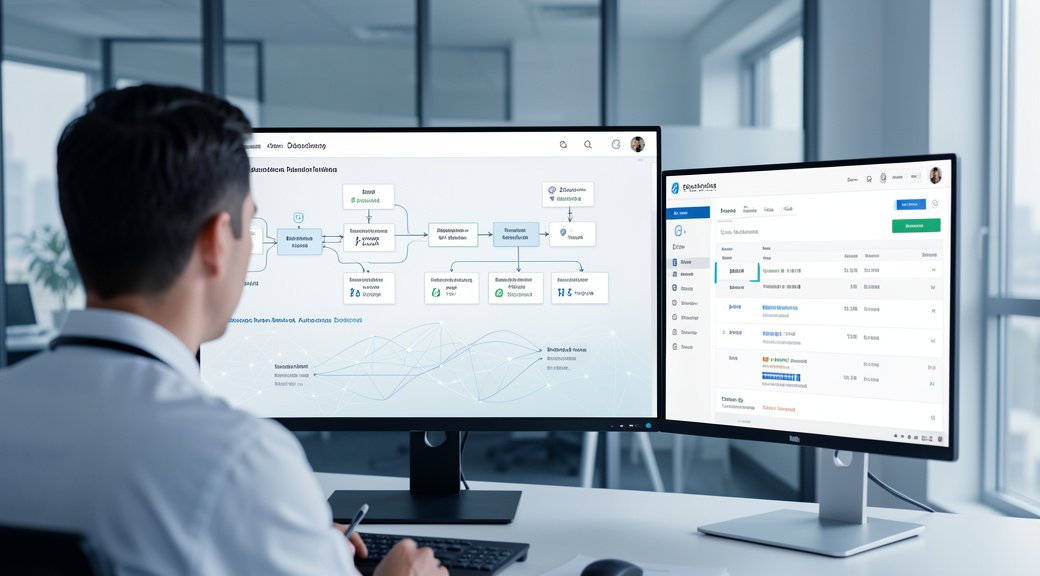
For US healthcare businesses, from independent clinics to multi-location specialty practices, the core operational challenge is not a lack of technology, but a proliferation of disconnected tools that create administrative drag. The real problem is that revenue-generating clinical time is being consumed by manual data entry, appointment scheduling, patient intake, and billing follow-up. This isn’t just an inconvenience; it’s a direct constraint on growth, profitability, and patient care quality. In a sector defined by thin margins, regulatory complexity, and intense competition for talent, manual processes are a luxury no business can afford.
This article provides healthcare operators and founders with a structured framework for implementing AI solutions for healthcare businesses. We will move beyond the hype to analyze the root causes of operational inefficiency, quantify their financial impact, and outline a phased approach to building intelligent automation. You will gain a clear understanding of how to leverage AI not as a standalone gadget, but as integrated infrastructure that scales your capacity, improves patient outcomes, and creates a sustainable competitive advantage.
The Root Cause: Disconnected Systems and Manual Workflow Gaps
The inefficiency in healthcare operations rarely stems from a single source. It’s the cumulative effect of legacy systems, point solutions, and human-dependent processes that were never designed to work together. The electronic health record (EHR) may be the system of record, but it often fails to communicate seamlessly with practice management software, billing systems, patient portals, or marketing platforms.
The Silo Effect on Staff and Patients
This disconnect forces staff to become human middleware, manually transferring information between systems. A patient calls to reschedule; the front desk updates the calendar but may forget to trigger a reminder via the patient portal. A claim is denied; the billing specialist must log into a separate clearinghouse portal, decipher the reason, and re-enter data into the billing module. Each handoff is a point of friction, delay, and potential error.
Data Rich, But Insight Poor
Healthcare generates vast amounts of data,clinical notes, lab results, insurance codes, patient communications. Yet, without intelligent systems to synthesize this information, it remains inert. Leaders lack real-time visibility into no-show rates, claim denial patterns, or staff utilization, making strategic decisions reactive rather than proactive.
The Operational and Financial Impact of Inefficient Processes
The cost of manual processes extends far beyond labor hours. It creates a cascade of negative effects that stifle growth and erode margins.
Direct Revenue Leakage: Inefficient patient scheduling leads to unfilled slots. Manual claim submission and follow-up result in slower reimbursements and higher denial rates. Studies consistently show that a significant percentage of denied claims are never re-submitted, representing pure revenue loss.
Capacity Constraint: Your most valuable asset,clinical providers,spends excessive time on documentation. Administrative staff is overwhelmed with repetitive tasks, limiting their ability to focus on patient experience or strategic projects. This creates a hard ceiling on the number of patients you can serve without proportionally increasing overhead.
Burnout and Turnover: Staff frustration with cumbersome systems is a leading cause of burnout in healthcare. High turnover among administrative and clinical staff is devastatingly expensive, involving recruitment costs, training time, and lost institutional knowledge.
Patient Experience Erosion: Long hold times, scheduling errors, and confusing financial communications degrade patient trust and satisfaction. In a competitive market, this directly impacts patient retention and referrals.
Common Mistakes in Adopting Healthcare AI Solutions
Many healthcare businesses approach AI with the wrong mindset, leading to failed implementations and wasted investment.
Mistake 1: Chasing Shiny Objects Over Core Processes
The allure of advanced diagnostic AI can be strong, but for most small to mid-market businesses, the highest ROI lies in automating back-office and patient-flow operations first. Implementing AI for prior authorization or patient intake has a more immediate and measurable impact on the bottom line than experimental clinical tools.
Mistake 2: Treating AI as a Point Solution, Not Integrated Infrastructure
Purchasing a standalone chatbot or a scheduling bot that doesn’t integrate with your EHR and practice management system creates yet another silo. True efficiency comes from AI that acts as a connective layer between your existing systems, like a multi-agent system orchestrating workflows across platforms.
Mistake 3: Underestimating the Need for Customization
Off-the-shelf AI tools often fail to account for your specific workflows, payer mix, or specialty requirements. Effective AI automation for business growth requires a degree of customization to fit seamlessly into your operational reality, something that generic SaaS products rarely provide.
Mistake 4: Neglecting the Human-in-the-Loop Design
AI should augment, not replace, human judgment in healthcare. The best systems are designed with clear escalation paths. For example, an AI customer support agent for patient inquiries should seamlessly transfer complex or sensitive issues to a human staff member with full context.
A Structured Framework for Implementing AI in Healthcare Operations
A successful AI implementation follows a disciplined, phased approach focused on infrastructure and measurable outcomes.
Phase 1: Process Audit and Prioritization
Map your key patient and revenue workflows from end to end. Identify the tasks that are high-volume, repetitive, rule-based, and prone to error. These are your prime automation candidates. Common high-impact starting points include:
- Patient appointment scheduling, reminders, and confirmations
- New patient intake and form collection
- Insurance verification and prior authorization initiation
- Basic patient Q&A (hours, directions, billing questions)
- Claim status follow-ups and denial management triage
Phase 2: Infrastructure and Integration Assessment
AI is only as good as the data it can access and the actions it can trigger. This phase involves evaluating your current technology stack’s APIs and data structures. Can your systems communicate? This is where custom software & database scalability becomes critical. Often, building a lightweight middleware layer or custom integrations is necessary to enable AI agents to work across your EHR, PM, and CRM systems, much like the foundational work described in SaaS product development frameworks.
Phase 3: Pilot Development and Integration
Select one high-impact, contained process for your pilot. Develop or configure the AI solution with a strong “human-in-the-loop” design. For instance, deploy an AI virtual agent to handle after-hours appointment requests. Ensure it integrates with your real-time scheduling API and escalates exceptions. This mirrors the principle of building website development as a revenue engine,the technology must be deeply connected to core business functions.
Phase 4: Measure, Refine, and Scale
Define clear KPIs for the pilot: reduction in staff time spent on the task, increase in after-hours appointment capture, patient satisfaction scores. Analyze the results, refine the AI’s workflows and knowledge base, and then systematically expand to other processes. This iterative, data-driven approach is the hallmark of building a foundation for sustainable business growth.
The Strategic Role of Systems: Beyond Tactical Automation
At its highest level, AI in healthcare transitions from automating tasks to orchestrating intelligent systems. This is where operational efficiency translates directly into market advantage.
AI as the Core of Business Process Automation
Intelligent automation becomes the central nervous system of your operations. It connects patient acquisition, onboarding, care delivery, and revenue cycle management into a cohesive, data-flowing whole. This is the evolution from robotic process automation for simple tasks to a holistic system that learns and adapts.
Enhancing Conversion-Focused Patient Acquisition
Your public-facing digital presence must work in concert with operational AI. A prospective patient visiting your website should encounter a seamless path. Essential website design establishes trust, while integrated tools allow for immediate, AI-assisted scheduling or inquiry handling, converting interest into appointments without staff intervention. This creates a true conversion-focused website infrastructure.
Data Intelligence for Strategic Decision-Making
As AI systems handle transactions, they generate rich data. This data can inform which services are in highest demand, which referral sources are most valuable, and where operational bottlenecks persist. This intelligence allows leadership to make strategic decisions about resource allocation and growth initiatives, moving the practice from reactive management to proactive leadership.
The Infrastructure Mindset: Building for Scale
Just as you wouldn’t build a clinic on a shaky foundation, your technology must be built to scale. This means selecting or building AI solutions on robust, secure platforms. It requires the same strategic forethought as e-commerce website development for scalable retail, ensuring the architecture can handle increased patient volume and new service lines without costly re-engineering.
Implementation Considerations for Healthcare Leaders
Moving from framework to execution requires careful planning.
Compliance and Security (HIPAA): Any AI solution must be contractually a Business Associate and built on a HIPAA-compliant infrastructure. Data encryption, access controls, and audit trails are non-negotiable.
Change Management: Staff may fear job displacement. Frame AI as a tool to eliminate their most tedious tasks, freeing them for higher-value, patient-focused work. Involve them in the design and pilot process.
Vendor vs. Custom Build: Off-the-shelf solutions offer speed but may lack integration depth. Custom development, as explored in discussions on modern web development services, offers perfect fit and ownership but requires greater upfront investment. A hybrid approach,customizing a core platform,is often optimal.
Starting Point: Begin with the most painful, high-volume administrative process. Demonstrate quick wins, build internal confidence, and generate ROI to fund subsequent phases.
Frequently Asked Questions
Is AI secure and HIPAA-compliant for patient data?
AI itself is a methodology, not a product. Security depends on the implementation. Working with a partner who prioritizes building conversion infrastructure with enterprise-grade security ensures solutions are built on HIPAA-compliant platforms with proper Business Associate Agreements (BAAs), data encryption, and access controls from the ground up.
What’s the typical ROI timeline for AI automation in a practice?
For well-scoped administrative automations (scheduling, intake), practices often see an ROI within 6-12 months. The return comes from reduced staff overtime, lower turnover, increased patient volume per provider, and improved cash flow from faster, cleaner billing. The key is precise targeting, as outlined in integrating AI into modern development practices.
Will AI replace my administrative staff?
The goal is augmentation, not replacement. AI handles repetitive, transactional tasks, allowing your staff to focus on complex patient communication, problem-solving, and relationship-building. This leads to more fulfilling roles and reduces burnout-driven turnover.
How do we ensure the AI provides accurate information to patients?
Effective AI is built with a tightly controlled knowledge base, regular training on your specific policies and FAQs, and clear guardrails. It must be designed to confidently handle common queries and default to a human escalation path for anything outside its defined scope, ensuring accuracy and patient safety.
Can small, independent practices afford custom AI solutions?
The landscape has changed. Cloud-based AI services and modular development approaches have made sophisticated automation accessible. The question is not if you can afford the solution, but if you can afford the ongoing cost of manual inefficiency. A strategic partner can help phase implementation to align with budget, focusing on the highest-impact areas first.
How does AI integrate with our existing EHR and practice management software?
Integration occurs primarily through secure APIs (Application Programming Interfaces). A competent development partner will assess your existing software’s API capabilities and build connectors that allow the AI system to read and write data (e.g., check appointment slots, create new patient records) following strict security protocols.
Conclusion
For US healthcare businesses, AI is not a futuristic concept but a present-day operational necessity. The strategic imperative is to stop viewing AI as a collection of discrete tools and start building it into the core infrastructure of your business. The goal is to create a self-reinforcing system where intelligent automation increases capacity, improves patient experience, and generates the data needed for smarter growth decisions.
This requires a shift from tactical problem-solving to a systems mindset. It means investing in infrastructure that connects rather than isolates, and partnering with experts who understand that technology must serve business outcomes, not the other way around. The path forward is clear: automate the predictable to empower the human, and build a foundation that scales not just with patient volume, but with your ambition.
