
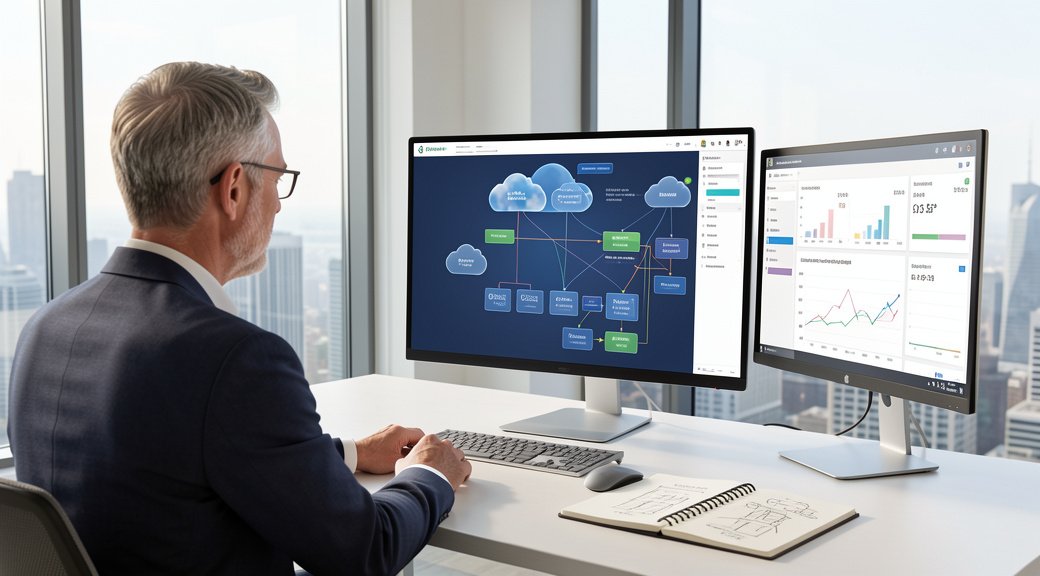
For US small and lower mid-market businesses, the promise of cloud application development is often overshadowed by a harsh reality: custom software projects that fail to deliver measurable ROI, become technical debt traps, or simply cannot scale with growth. The core problem isn’t a lack of available technology, but a fundamental misalignment between development efforts and sustainable business operations. Founders and operators invest in custom applications to solve specific problems,streamlining a unique workflow, capturing a new market opportunity, or automating a core process,only to find themselves managing fragile infrastructure, escalating maintenance costs, and software that becomes a bottleneck instead of an accelerator.
This article provides a structured, non-hyped framework for approaching cloud application development as a business growth system. You will gain a clear understanding of how to align technical investment with operational and revenue goals, avoid common pitfalls that cripple scalability, and implement a development philosophy that treats your application as scalable business infrastructure, not just a software project. We will focus on the strategic integration of automation, data architecture, and conversion-focused principles to ensure your cloud application becomes a durable asset.
The Root Cause: Treating Development as a Project, Not a Growth System
The most significant error businesses make is viewing cloud application development as a finite project with a clear end date. This “project mindset” leads to short-term technical decisions, isolated development sprints disconnected from evolving business processes, and a handoff that leaves internal teams without the tools or knowledge to adapt the system.
Operational and Financial Impact of the Project Mindset
When development is siloed, the consequences are systemic. Operationally, you create software that automates a task but not a process. It becomes a digital island, unable to share data with your CRM, e-commerce platform, or marketing analytics. This creates manual workarounds, data reconciliation headaches, and limits visibility. Financially, the initial development cost is just the entry fee. The real expense emerges in the form of missed opportunities due to slow feature deployment, high-cost developer interventions for minor changes, and the eventual need for a costly “version 2.0” rebuild when the initial architecture hits a hard scalability wall. This approach contradicts the very purpose of investing in modern web development services, which should deliver adaptable, integrated systems.
Common Strategic Mistakes in Business Application Development
Beyond the overarching project mindset, several tactical mistakes consistently undermine the value of cloud applications for US businesses.
- Prioritizing Features Over Data Flow: Teams list desired functionalities without first mapping the critical data entities, their relationships, and how data must flow to drive decisions. This results in applications that can “do” things but cannot provide intelligent insight.
- Neglecting the Automation Layer: Building an application that merely digitizes a form is a missed opportunity. The strategic value lies in using the application to trigger and manage automated workflows,approvals, notifications, data enrichment, report generation,freeing human capital for higher-value work.
- Underestimating Integration as a Core Requirement: Treating integrations with tools like Salesforce, QuickBooks, or marketing platforms as “phase two” deliverables ensures your application will never become central to operations. Integration must be a first-class architectural concern.
- Building Without a Conversion or Action Framework: Even internal tools should be designed with user action in mind. Whether it’s a field rep submitting a quote or a manager approving a budget, the application’s interface and logic must be built to reduce friction and guide users toward completion, a principle central to website development as a revenue engine.
A Structured Framework: Cloud Development as Business Infrastructure
To avoid these pitfalls, shift your perspective. Your cloud application is not a software project; it is a piece of business infrastructure. The following framework ensures this infrastructure supports growth.
1. Process Definition Before Code Definition
Do not start with a developer. Start by mapping the exact business process the application will serve or create. Document every step, decision point, data input, and output. Identify which steps are prime for pure automation versus those requiring human judgment. This exercise alone often reveals inefficiencies that can be solved without any code. The output of this phase is not a feature list, but a clear process blueprint that becomes the source of truth for development, aligning with strategies for robotic process automation and broader business process design.
2. Data Architecture as the Foundation
The longevity and flexibility of your application depend entirely on its data architecture. This involves deliberately designing how data is structured, stored, related, and accessed. Key considerations include ensuring the database can scale with increased users and data volume, structuring data to support future reporting needs, and planning for secure, efficient connections to other business systems. Robust custom software & database scalability is not an add-on; it is the core of a durable application.
3. Designing for Automation and Action
With a solid process map and data foundation, you can now design the application layer. This is where you embed automation triggers and design for user conversion. For example, upon form submission (the action), the system should automatically validate data, update related records, assign a task to a team member, and send a confirmation,all without human intervention. This transforms the application from a passive tool into an active participant in your operations, a concept explored in depth regarding AI automation for business growth.
4. Integration-First Development
Adopt an “integration-first” mentality. Define the APIs and data exchange protocols with your other critical systems (e.g., ERP, email marketing, payment gateways) at the start. This ensures the application is built to be a connective node in your technology ecosystem, not a standalone entity. It enables a unified data layer that powers better business intelligence.
Implementation: The Role of Systems and Strategic Partnerships
Implementing this framework requires a systems-oriented approach to technology execution. This is where the distinction between a tactical developer and a strategic technology partner becomes critical.
Building on a Conversion-Focused Foundation
The principles of user-centric design and frictionless interaction are not exclusive to customer-facing websites. Your internal or B2B cloud applications must also be built on a conversion-focused website infrastructure philosophy. This means intuitive navigation, clear data presentation, logical workflow progression, and minimizing clicks to complete a task. High adoption and accurate data entry depend on it.
Leveraging AI and Automation Strategically
Modern cloud development should strategically incorporate AI not as a buzzword, but as embedded functionality. This could be machine learning models for predictive analytics within the app, natural language processing for parsing unstructured data inputs, or chatbots for internal Q&A. The goal is to make the application more intelligent and autonomous over time, moving towards more advanced multi-agent systems for complex process orchestration.
Ensuring Organic Growth Through Maintainability
A cloud application must be built to evolve. This requires clean, documented code, a sensible technology stack, and a deployment process that allows for frequent, low-risk updates. The application’s ability to grow and adapt without a full rewrite is a key determinant of its long-term ROI. This principle of building adaptable assets mirrors the approach needed for SEO optimized website development, where the foundation must support continuous content and technical evolution.
The Partner Imperative: Beyond Code Delivery
For most businesses, building this type of systemic infrastructure requires a partner who thinks in terms of business outcomes, not just code completion. The right partner will challenge your process maps, advocate for scalable data architecture, and view the application as one component in your broader strategic framework for sustainable growth. They provide the ongoing stewardship needed to ensure the application scales, integrates, and automates as your business changes.
Frequently Asked Questions
How do we justify the higher initial cost of a well-architected cloud application?
The justification is total cost of ownership and opportunity enablement. A cheaper, poorly architected app incurs massive hidden costs in maintenance, developer lock-in, and inability to scale. The well-built app avoids costly rebuilds, enables faster feature deployment, and directly automates operational expenses, paying for itself through efficiency and new capabilities.
Should we use low-code platforms or custom development?
Low-code is excellent for well-defined, simple workflows and rapid prototyping. Custom development is necessary for complex, unique business logic, deep integrations, scalable data architectures, and applications that provide a true competitive advantage. The decision hinges on the complexity of your process and strategic importance of the application.
How do we ensure our team will actually use the new application?
Adoption is designed, not mandated. Involve end-users in the process mapping stage. Build an interface that is intuitive and reduces their workload, not adds to it. Focus relentlessly on eliminating friction and demonstrating how the tool makes their job easier. Training and support are critical, but adoption starts with user-centric design.
What are the key security considerations for a custom cloud application?
Beyond standard encryption, consider role-based access controls (RBAC), audit logging for all data changes, secure API authentication, regular vulnerability scanning, and compliance with relevant standards (e.g., SOC 2, industry-specific regulations). Security must be baked into the architecture from day one.
How do we measure the ROI of a custom cloud application?
Track metrics defined during the process phase: time saved (converted to labor cost), reduction in error rates, increase in process throughput (e.g., orders processed per hour), improved data accuracy for decision-making, and new revenue enabled by the application’s functionality. ROI should be measured in operational and financial gains.
Conclusion: From Cost Center to Growth Infrastructure
Cloud application development, when executed with a systems mindset, transcends its traditional role as an IT cost center. It becomes a primary engine for business growth, enabling automation, providing unparalleled operational insight, and creating agile responses to market opportunities. The shift required is fundamental: stop buying features and start investing in adaptable, intelligent, and integrated business infrastructure.
This structured approach prioritizes long-term execution over short-term delivery. It demands upfront rigor in process and architecture to unlock sustained scalability and value. For US small and mid-market businesses, this is the path to leveraging technology not as a necessary expense, but as a foundational pillar of competitive advantage and sustainable growth. The goal is to build systems that work for you, not projects you work for.
