
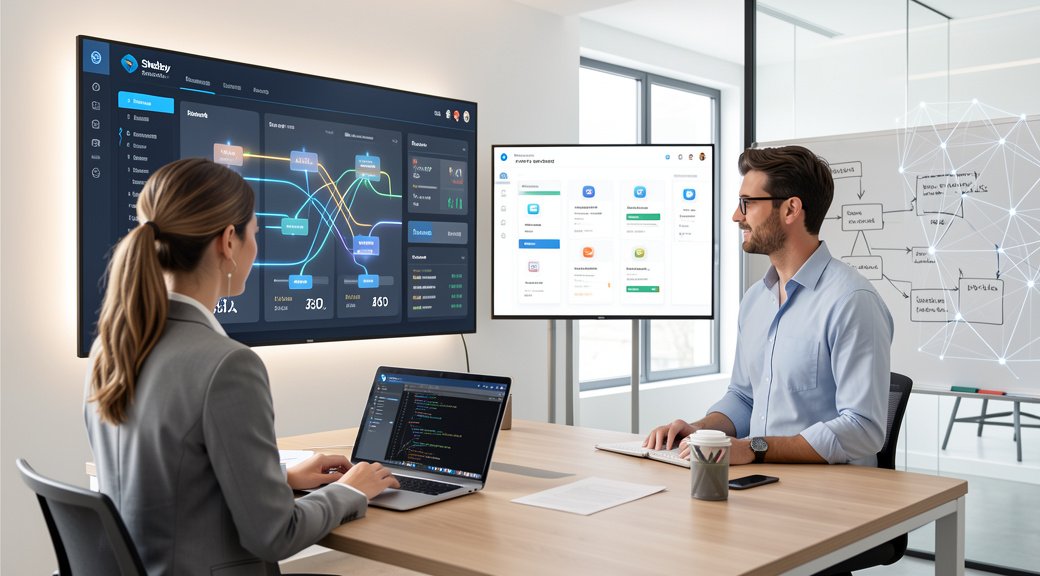
For US small and lower mid-market businesses, the promise of internal business tools is often overshadowed by a frustrating reality: a growing collection of disconnected applications that create more complexity than they solve. Decision-makers invest in point solutions for sales, project management, and customer support, only to find their teams bogged down by manual data entry, inconsistent processes, and information trapped in departmental silos. This operational drag isn’t just an inconvenience,it directly limits revenue growth, erodes profit margins, and prevents scalable execution. The core problem isn’t a lack of tools, but a lack of a cohesive system.
This article provides a strategic framework for evaluating, implementing, and scaling internal business tools as integrated systems. You’ll learn how to move beyond tactical software purchases to build operational infrastructure that reduces costs, accelerates growth, and creates durable competitive advantages. We’ll analyze the root causes of tool sprawl, quantify its financial impact, and outline a structured approach to building a technology stack that functions as a true business asset.
The Hidden Cost of Disconnected Internal Tools
Most businesses don’t set out to create a fragmented technology environment. It happens incrementally, as teams adopt tools to solve immediate, localized problems without considering the broader operational architecture. The result is a patchwork of applications that fail to communicate, creating significant hidden costs.
Root Cause Analysis: Why Tool Sprawl Happens
Tool proliferation typically stems from three systemic issues. First, departmental autonomy without centralized governance leads to isolated purchasing decisions. A marketing team adopts one CRM, while sales chooses another, creating immediate data fragmentation. Second, businesses prioritize immediate feature needs over long-term integration capabilities, opting for quick-fix solutions that can’t scale. Third, there’s often a fundamental misunderstanding that more software equals more efficiency, when in reality, each new disconnected tool adds cognitive load and process overhead.
This approach ignores the foundational principle that effective business technology solutions must be built as interconnected systems, not isolated applications.
Quantifying the Operational and Financial Impact
The consequences are measurable. Employees waste hours each week manually transferring data between systems,a direct productivity tax. Decision-makers work with inconsistent reports because each tool calculates metrics differently. Customer experience suffers when service teams lack a unified view of client history. Perhaps most critically, innovation stalls because technical debt and integration complexity make it prohibitively difficult to adapt systems to new business models or market opportunities.
Financially, this manifests as redundant software subscriptions, higher IT support costs, and missed revenue opportunities from inefficient processes. A strategic approach to modern web development services and internal platforms can transform this cost center into a growth engine.
Common Mistakes in Building Internal Tool Infrastructure
Recognizing these pitfalls is the first step toward building better systems. The most frequent mistakes include:
- Tool-First Thinking: Starting with software selection rather than process analysis. Businesses buy a project management tool before defining their ideal workflow, forcing processes to conform to software limitations rather than building tools that enable optimal workflows.
- Ignoring Data Architecture: Failing to establish how data will flow between systems before implementation. This creates permanent integration challenges and limits future analytics capabilities.
- Over-Customization of Off-the-Shelf Solutions: Heavily modifying generic SaaS platforms to fit unique business needs, creating upgrade nightmares and vendor lock-in, when custom software development might provide a more sustainable solution.
- Neglecting User Adoption Systems: Assuming that if you build it, they will come. Implementing powerful tools without parallel investment in training, change management, and ongoing support guarantees low utilization.
These errors stem from viewing tools as tactical purchases rather than strategic infrastructure. The correction requires a fundamental shift in perspective.
A Structured Framework for Internal Tool Integration
Building effective internal systems requires moving from a collection of tools to an integrated technology stack. This framework focuses on business outcomes rather than software features.
Phase 1: Process Mapping and Bottleneck Identification
Begin by documenting core workflows,lead-to-cash, product development, customer onboarding,without reference to current tools. Identify where handoffs between departments or systems create friction, delays, or errors. Quantify the time and cost of these bottlenecks. This exercise reveals where integration will deliver the highest return, whether through business process automation or improved data connectivity.
Phase 2: Defining the Data Core
Determine your single source of truth for each critical data entity: customer, product, order, employee. Design how this data will flow between systems. This often involves establishing a central customer database or data warehouse that feeds operational systems, rather than allowing each tool to maintain its own conflicting records. This data-first approach is fundamental to custom software & database scalability.
Phase 3: Strategic Tool Selection and Integration
Evaluate potential tools based on integration capabilities (APIs, webhooks, native connectors) as critically as their core features. Prioritize platforms that play well within an ecosystem. For areas where off-the-shelf solutions create compromise, consider targeted custom development to bridge gaps or automate unique processes. The goal is a cohesive stack, not a collection of best-in-class point solutions that don’t communicate.
The Strategic Role of Automation and AI in Internal Systems
Once foundational integration is established, automation and AI transform internal tools from systems of record to systems of intelligence and action. This represents the evolution from simply storing data to leveraging it for operational advantage.
Automating Routine Workflows
Identify repetitive, rules-based tasks that currently require manual intervention between systems: data entry, report generation, status updates, notification triggers. Implementing workflow automation here delivers immediate ROI by freeing employee capacity for higher-value work. This is where responsive web architecture and API-driven design enable seamless machine-to-machine communication.
Intelligent Process Enhancement with AI
Beyond automation, AI agents can manage complex internal processes that require judgment. Examples include triaging customer support tickets by intent and urgency before human review, dynamically allocating resources across projects based on real-time progress data, or analyzing sales activity to recommend next-best actions. These systems function as force multipliers, embedding institutional knowledge and optimal decision patterns into daily operations.
The key is to implement AI where it augments human capability, not where it adds another layer of complexity. A well-designed internal tool stack makes this augmentation possible by providing clean, structured data feeds.
Implementation Considerations for Sustainable Systems
Successful execution requires attention to both technical and human factors. Technically, prioritize API-first tools and maintain clear documentation of all integrations and data flows. Architect for observability,build dashboards that monitor system health and data quality, not just business metrics.
On the human side, treat internal tool implementation as an organizational change initiative. Designate power users from each department as champions. Create realistic training materials that focus on workflow outcomes, not software features. Establish a feedback loop where user experience directly informs system refinements. This holistic approach ensures that your technology infrastructure actually gets used and improves over time.
Connecting Internal Tools to Customer-Facing Growth
The most powerful internal systems don’t just improve efficiency,they directly enhance customer acquisition and retention. A unified customer data platform enables personalized marketing at scale. Integrated project management and CRM systems provide sales teams with real-time delivery capacity insights, allowing for more accurate commitments. Streamlined quote-to-cash processes reduce friction for buyers.
This connection is why internal tools must be considered alongside customer-facing website infrastructure. The two systems should share data and triggers. A website form submission should automatically create records in both marketing and sales tools. A support ticket resolution should trigger a customer satisfaction survey. This closed-loop system turns internal efficiency into external competitive advantage.
Building for Long-Term Evolution, Not Just Immediate Needs
The business needs of 2026 will differ from today’s requirements. Your internal tool infrastructure must be built to evolve. This means selecting platforms with robust APIs, avoiding vendor lock-in where critical processes are concerned, and maintaining clean data exports. It means building modular systems where components can be upgraded or replaced without catastrophic disruption.
This evolutionary approach is particularly important for digital marketing integration and sales tools, where channels and tactics change rapidly. Your internal systems should enable experimentation and adaptation, not hinder it.
Frequently Asked Questions
How do we justify the investment in integrating internal tools when individual departments are satisfied with their current solutions?
Focus on cross-departmental bottlenecks and lost revenue opportunities. Calculate the cost of manual data reconciliation, the delay in decision-making due to inconsistent reports, and the customer experience degradation from departmental silos. The ROI comes from enterprise-wide efficiency gains, not individual departmental satisfaction.
Should we build custom tools or integrate existing SaaS platforms?
The strategic approach is a hybrid. Use robust SaaS platforms for standardized functions (CRM, accounting) where innovation is less critical. Invest in custom development or significant customization for processes that are unique to your competitive advantage or where existing solutions create unacceptable compromise. The decision should be based on strategic importance, not just technical feasibility.
How do we manage the change resistance when introducing new integrated systems?
Involve end-users from the discovery phase. Frame changes around eliminating their pain points (e.g., “this will eliminate the daily report you manually compile”). Provide extensive, role-specific training focused on workflows, not software. Designate departmental champions and celebrate quick wins publicly to build momentum.
What’s the first step if our tool sprawl is already severe?
Conduct an audit. Catalog all software subscriptions, their primary users, and their integration points. Identify redundant tools and those with minimal usage. Then, select one critical business process (often lead-to-cash or order fulfillment) and map its current flow across all tools. Use this single process as a pilot for integration and optimization before tackling the entire stack.
How does AI fit into our internal tool strategy?
AI should be applied to automate complex decision workflows, not as a standalone tool. Start by identifying decisions that require synthesizing data from multiple current systems (e.g., prioritizing sales leads, forecasting project timelines). AI agents can be built to access these integrated data streams and execute defined decision protocols, freeing human capacity for exception handling and strategy.
Conclusion: From Tool Collection to Operational System
For US small and mid-market businesses, the path to scalable growth is paved with operational efficiency. Disconnected internal tools create friction that limits revenue capacity and erodes margins. The solution requires a shift in perspective,from evaluating software based on feature checklists to architecting integrated systems that streamline core business workflows.
The most successful operators treat their internal technology stack as strategic infrastructure. They invest in integration with the same seriousness as customer-facing systems. They prioritize data flow over isolated functionality. They build platforms that can evolve with their business, turning operational efficiency from an aspiration into a durable competitive advantage.
This systematic approach transforms internal tools from a cost center into a growth engine. It’s how businesses move beyond simply working harder to working smarter,building systems that scale with ambition, reduce operational drag, and create the foundation for sustainable expansion. The work isn’t in buying more software, but in building the connections that make your entire business operate as a unified, intelligent system.
