
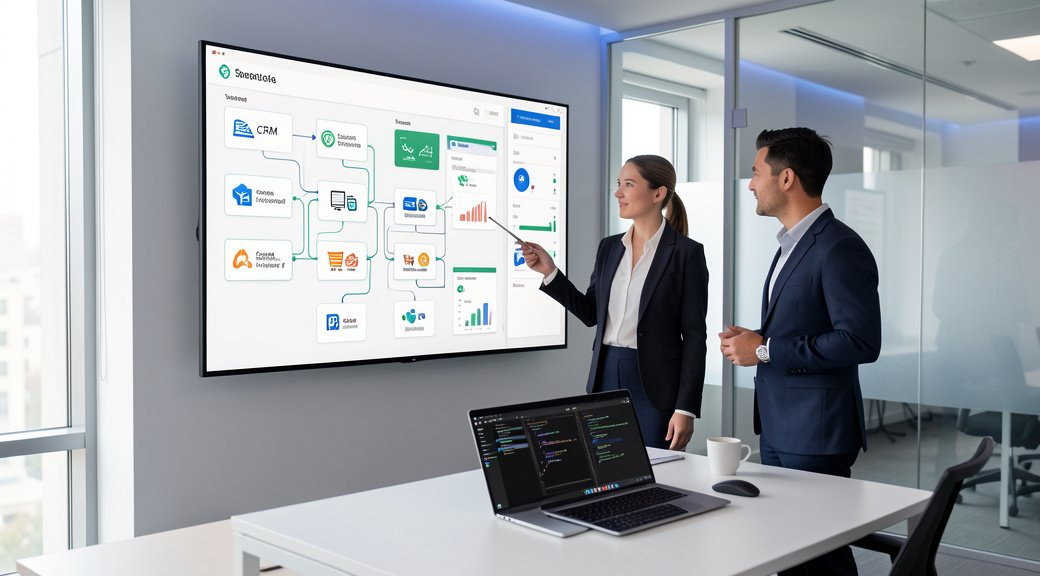
When your CRM doesn’t talk to your accounting platform, and your inventory system operates in a silo from your ecommerce store, you’re not just dealing with inconvenience,you’re losing revenue. For US small and lower mid-market businesses, disconnected systems create operational drag that slows growth, frustrates teams, and erodes margins. Enterprise system integration solutions address this directly by connecting your core business applications into a unified operational infrastructure. In this article, you’ll learn the root causes of system fragmentation, its financial impact, common integration mistakes, and a structured framework for selecting and implementing integration solutions that scale with your business.
The Real Cost of Disconnected Systems
Disconnected systems force employees to manually transfer data between platforms. A sales rep enters a new customer into the CRM, then manually types the same information into the invoicing system. An operations manager exports inventory counts from a warehouse tool and imports them into the ERP. These manual workflows are error-prone, time-consuming, and expensive.
According to industry research, data professionals spend up to 40% of their time on manual data entry and reconciliation tasks. For a mid-market business with a 10-person operations team, that translates to roughly four full-time salaries lost each year to non-value-added work. The real cost isn’t just labor,it’s the missed revenue from slow order processing, delayed customer responses, and decisions made on stale or inaccurate data.
Operational Impact
- Order processing delays: When sales and fulfillment systems aren’t integrated, orders can sit in queue for hours or days while staff manually verify inventory and payment status.
- Customer experience friction: Support agents who lack visibility into order history or shipping status cannot resolve issues quickly, leading to churn.
- Reporting inaccuracy: Leaders make strategic decisions based on spreadsheets that are already outdated by the time they’re compiled.
- Compliance risks: Manual data transfers increase the likelihood of errors in financial reporting, tax filings, and regulated data handling.
Financial Impact
Beyond labor waste, disconnected systems create hidden costs. Duplicate software licenses, failed data migrations, and emergency IT fixes all eat into margins. A mid-market manufacturer with annual revenue of $10 million might lose $200,000,$500,000 annually due to integration gaps, according to estimates from operational efficiency benchmarks. These losses compound as the business grows, making system fragmentation a direct threat to scalability.
Why Small and Mid-Market Businesses Face Integration Challenges
Enterprise integration isn’t a new problem, but it has become more acute for smaller businesses in recent years. The proliferation of SaaS tools,averaging 130+ applications per mid-market organization,has created a complex web of point solutions that were never designed to work together.
Root Causes
- Rapid tool adoption without architecture: Teams purchase best-of-breed tools to solve immediate problems without considering long-term integration requirements.
- Limited IT resources: Unlike large enterprises with dedicated integration teams, small and mid-market businesses often rely on a single IT generalist or outsourced support.
- Legacy system constraints: Older on-premise systems may lack modern APIs, making integration expensive or technically difficult.
- Vendor lock-in concerns: Some vendors intentionally limit integration capabilities to discourage switching.
Common Mistakes Businesses Make with Integration
Attempting to solve integration problems without a strategy often leads to worse outcomes. Here are the most frequent errors we observe.
Mistake 1: Building Custom Point-to-Point Connections
It’s tempting to hire a developer to build a one-off script that connects your CRM to your invoicing tool. But as the number of systems grows, point-to-point connections create a brittle, unmanageable spiderweb. Each connection requires maintenance, breaks when either system updates, and lacks monitoring or error handling.
Mistake 2: Choosing Integration Tools Before Defining Requirements
Many businesses purchase an integration platform as a service (iPaaS) based on features, not fit. Without a clear understanding of data volumes, frequency of syncs, and business rules, the chosen tool often proves too rigid or too complex for the actual use case.
Mistake 3: Underinvesting in Data Quality
Integration doesn’t solve dirty data problems,it amplifies them. If your CRM contains duplicate customer records or inconsistent product codes, an integration will propagate those errors across all connected systems. Cleaning data before integration is non-negotiable.
Mistake 4: Ignoring Security and Compliance
Moving data between systems introduces new attack surfaces. Businesses that fail to encrypt data in transit, implement access controls, or maintain audit trails expose themselves to breaches and regulatory penalties.
A Structured Framework for Enterprise System Integration Solutions
Successful integration requires a systematic approach. The following framework helps small and mid-market business leaders evaluate their needs and select appropriate enterprise system integration solutions.
Phase 1: Discovery and Mapping
Begin by documenting every business application in use, the data they contain, and how data currently flows between them. Identify manual touchpoints where employees copy or reformat data. Prioritize integration opportunities based on frequency of use, error rates, and business impact.
Phase 2: Define Integration Patterns
Not all integrations are created equal. Classify each connection by pattern:
- Synchronous: Real-time data exchange, critical for order processing and customer-facing operations.
- Asynchronous: Batch updates for non-time-sensitive data like nightly inventory syncs.
- Event-driven: Triggered by specific actions, such as creating a support ticket when a payment fails.
This classification guides technology choices and determines infrastructure requirements.
Phase 3: Select Integration Architecture
Three primary architectures serve small and mid-market businesses:
- Integration Platform as a Service (iPaaS): Cloud-based middleware that connects applications via pre-built connectors. Best for businesses with standard SaaS tools and limited technical resources.
- Enterprise Service Bus (ESB): More robust architecture for complex, high-volume environments. Suitable for businesses with custom applications or hybrid on-premise/cloud environments.
- Custom API Development: Tailored connections built by a development partner. Necessary when unique business logic or legacy systems require specialized handling.
Phase 4: Implement with Governance
Deploy integration solutions with clear ownership, monitoring, and documentation. Establish SLAs for data accuracy and sync frequency. Implement error handling and alerting so issues are addressed before they impact operations.
Strategic Role of Systems Integration in Business Growth
Enterprise system integration solutions are not just about fixing current pain points,they enable future growth. Integrated systems create a foundation for advanced capabilities that drive competitive advantage.
Enabling Business Process Automation & AI
Automation and AI depend on clean, connected data. When your systems are integrated, you can automate workflows that span multiple applications,for example, automatically updating customer records, generating invoices, and triggering fulfillment when a sales order is closed. AI models trained on integrated data produce more accurate predictions and recommendations. For a deeper look at how automation connects to broader business technology strategy, explore our guide on API integration services.
Supporting Conversion-Focused Website Infrastructure
Your website is a critical integration point. When it’s connected to your CRM, inventory system, and payment processor, you can deliver personalized experiences, accurate product availability, and seamless checkout. Integration turns a static website into a revenue engine.
Powering Custom Software & Database Scalability
Custom software solutions become exponentially more valuable when integrated with your existing tool stack. A custom ERP built on integrated data provides real-time visibility across sales, operations, and finance,giving decision-makers a single source of truth.
Implementation Considerations for US Small and Mid-Market Businesses
Integration projects can feel overwhelming, but they don’t have to be. The following considerations help ensure successful implementation.
Start Small, Prove Value
Begin with a single high-impact integration,connecting your CRM to your email marketing platform, for example. Measure the time saved, error reduction, and revenue impact. Use that success to build momentum for broader integration initiatives.
Choose the Right Partner
Integration requires expertise across multiple domains: data architecture, security, business process design, and vendor management. Look for a partner with experience in your industry and a track record of delivering scalable solutions for businesses of your size.
Plan for Maintenance
Integrations require ongoing attention. Systems update, business rules change, and data volumes grow. Budget for regular maintenance, monitoring, and optimization. A well-maintained integration pays for itself in operational efficiency.
Prioritize Data Security
Encrypt data both in transit and at rest. Implement role-based access controls. Maintain audit logs for compliance purposes. If you handle regulated data (PCI, HIPAA, GDPR), ensure your integration solution meets those requirements.
Measure What Matters
Track metrics that connect directly to business outcomes: order processing time, customer support resolution speed, data accuracy rates, and revenue per employee. Use these metrics to justify continued investment in integration infrastructure.
Frequently Asked Questions
How do I know if my business needs enterprise system integration solutions?
If your team spends more than a few hours per week manually transferring data between systems, if you have duplicate data across platforms, or if reporting requires significant manual effort, you likely need integration. The cost of manual work almost always exceeds the cost of a structured integration solution.
What is the typical cost of enterprise integration for a mid-market business?
Costs vary based on the number of systems, integration complexity, and architecture. Simple iPaaS implementations may start at $1,000,$5,000 per month. Custom integrations can range from $20,000 to $100,000+. A proper discovery phase will provide accurate estimates for your specific environment.
Should I build integration in-house or hire a partner?
Unless you have dedicated integration engineers on staff, a partner is usually more cost-effective. Specialized partners bring pre-built connectors, established methodologies, and experience avoiding common pitfalls. They also provide ongoing support that internal teams often cannot sustain.
How long does an integration project typically take?
A single system-to-system integration can take 4,8 weeks from discovery to go-live. Larger projects involving multiple systems and custom development may take 3,6 months. A phased approach delivers value faster and reduces risk.
What’s the difference between API integration and iPaaS?
API integration refers to the technical connection between two systems using their APIs. iPaaS is a platform that simplifies managing multiple API integrations through a unified interface, often providing pre-built connectors, monitoring, and error handling. For most mid-market businesses, iPaaS offers a better balance of capability and manageability.
Can integration help with compliance requirements?
Yes. Properly implemented integration provides a single, auditable data flow that reduces the risk of errors in financial reporting, tax filings, and regulated data handling. Integration also enables automated compliance checks and reporting, reducing the burden on your team.
Conclusion
Disconnected systems are a silent drag on growth for US small and lower mid-market businesses. The cost is measured in wasted labor, missed revenue, and strategic decisions made on incomplete data. Enterprise system integration solutions eliminate that drag by creating a unified operational infrastructure that scales with your business.
The path forward isn’t about buying more tools,it’s about connecting the ones you already have with a structured, scalable approach. Start with a discovery phase, prioritize high-impact integrations, and invest in architecture that supports automation, AI, and future growth.
At Shelby Group LLC, we help businesses like yours design and implement integration solutions that turn disconnected systems into a competitive advantage. Whether you need a single CRM-to-ERP connection or a comprehensive integration strategy, our team brings the technical expertise and business context to deliver results that matter.
